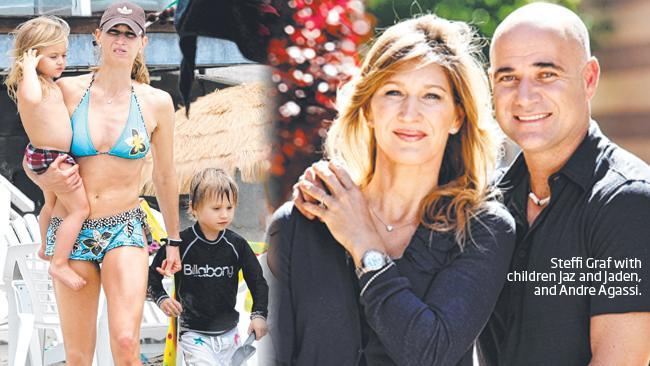
IF GENETICS are everything in sport, Jaden and Jaz Agassi should have been ready to rip a top-spin forehand from an early age.
IF GENETICS are everything in sport, Jaden and Jaz Agassi should have been ready to rip a top-spin forehand from an early age.
Their parents, Andre Agassi and Steffi Graf, won an astounding 30 Grand Slam titles between them, so a path to professional tennis seemed inevitable.
But at an age where many prodigies are being groomed by round-the-clock coaching, son Jaden and daughter Jaz hardly play tennis.
“Tennis? I just think we’ve had enough, quite honestly,” Agassi said bluntly, during an interview with The Sunday Mail last week. “It’s a weird sport. We don’t see too many second-generation players. For us, it’s about raising our children in a way we can share in their life and not always worry about their life.”
Instead of drilling their kids on court, Agassi and Graf are forever running them around the suburbs of Las Vegas for other sporting pursuits.
Jaden, 9, has developed a passion for baseball and is using his extraordinary hand-eye co-ordination to hit home runs.
Agassi turns up at the junior baseball like any other dad, but leaves the coaching to others.
“Jaden loves it and happens to be pretty good at it,” he said. “I have no idea what he should be doing or not doing. I just take him and help him as much as I can.”
And at the age of seven, Jaz is smitten with horseback riding and hip-hop dancing.
Graf, who won 22 Grand Slam trophies of her own, could not be more content.
“Jaz plays a little bit of tennis, Jaden not so much,” Graf said.
“We never really introduced tennis so much into their lives.
“They’ve chosen other things that we were surprised with . . . they love their arts and music.
“Jaden tried different sports, soccer and things and ended up with baseball. We nurture their desires and interests.”
Agassi famously revealed in his autobiography Open that he hated tennis, and described it as the loneliest sport possible.
“I believe that wholeheartedly.
“Where else do you see people talk to themselves that much, right? And answer themselves?” Agassi said of the mental challenges.
“It’s lonely . . . no one to talk to, no one to pass the ball to.”
Agassi, who is planning a return to Australia in January for the first time in six years in what would be an enormous boost for Melbourne’s Australian Open, will always stress to his kids that school comes first.
Just as his eyes started to sparkle about Jaden’s baseball prowess, Agassi quickly delivers a reality check.
“I put him in environments when he can learn and practise, but not ahead of his school,” Agassi said.
Now 41 and five years into retirement, education has become a big part of Agassi’s life in his home town. In 2001, he opened the Andre Agassi College Preparatory Academy.
It started with three grades and now has 12 and more than 600 students, almost 95 per cent African American.
Although the school is no more than a 15-minute drive from the famous Las Vegas strip, it is a galaxy away from the bright lights.
West Las Vegas is the poorest area of the gambling mecca. Cab drivers are reluctant to venture out among the shacks and dusty, overgrown front gardens.
But – like a beacon for the underprivileged in the streets nearby – there is an annual lottery to win a place at the school, and for good reason.
The school has had two graduating senior classes, in 2009 and 2010, for a 100 per cent transition into college.
There is not a tennis court in sight but the school offers baseball, volleyball, athletics, basketball and gridiron.
Agassi did not want the college to be perceived as merely a breeding ground for tennis players, disguised as an educational facility.
The schoolbooks come first.
“It’s been a dream of mine, dating way back to 1997,” Agassi said.
“I didn’t know what it would look like. I just had a vision of a child and a picture of what their eyes would look like with a little hope in them.
“I set about building it. It was a $40 million undertaking.
“I paid for a lot of it, raised a lot of it. It costs millions a year to subsidise how a child should be educated versus what their options are in our public education system.
“This is given to those kids who society is the quickest to write off.
“It is given to the poorest … they live in an impoverished neighbourhood.
“Any fast-growing city unfortunately has its share of poverty, its share of medical issues, its share of all sorts of concerns … but education has been top of that list for a while.
“We’ve had two graduating classes and they’ve all carried on to university, which means we were right.”
Agassi said the school, where students study for two hours a day more than their public counterparts, took up 70 per cent of his time.
“This is my focus. Occasionally, it’s bringing politicians through because I’m trying to get certain things passed, maybe I’m doing a tour for our new superintendent of the school district or at other times I’m bringing through donors and potential givers to the foundation.
“I separate myself from education because I acknowledge my lack of education.
“I put the right people in charge here. It needs to be run efficiently and by educators.”
Agassi lives across town with Graf, whom he married in 2001, and his children.
Las Vegas may have been a culture shock for the German Graf to begin with, but life could not be rosier in the Nevada desert with the support of extended family.
Graf, 41, said her mother Heidi moved to Vegas a year after the wedding. She also has a brother living nearby.
“It’s been easy. My mum moved and then my brother followed a few years later with his four kids,” Graf said. “Andre was born and raised here. We’re a big family and have lots of get-togethers and barbecues.
“A lot of things get me back to Germany. My foundation … I’ve still got an office and partnerships in Germany. In summer, we take the kids back to Europe as a family.”
Agassi’s mum, Betty, a breast cancer survivor, and his brother and his kids are never far away.
And the tennis legend’s former coach, Australian Darren Cahill, now lives around the corner and is regarded as family.
“Darren’s a great friend. One of the real good, good people,” Agassi said.
Cahill is doing development work in Vegas and has a commentary role on ESPN.
“This is his home now,” Agassi said, and Graf added she was thrilled to see their children grow up together.
“The two boys and now the two girls are close,” Graf said.
“The boys used to play on the same baseball team and they’ve actually played against each other – to see them growing up together is really neat.”