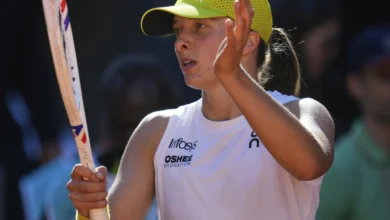
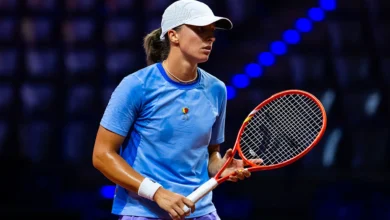
Australian Open Winner Ashleigh Barty on Making a Difference After a Challenging Year.

made history as the first Australian woman to take out the Australian Open in 44 years—to sum up her historic Wimbledon victory in July last year, she will likely reply that the stars simply aligned. It’s a statement that says a lot about the athlete who hails from Ipswich, west of Brisbane. Humble, matter-of-fact, and down-to-earth.
While factors leading up to the women’s singles finals at the iconic London lawn club did indeed fall into place, her response is not only simplistic, but far too modest for someone who recently celebrated her 100th week as world number one.
The 2021 tournament was a year like no other. It marked a decade since Barty, 25, had taken out the title as a junior tennis player, but more poignantly, it was 50 years since her mentor and fellow Indigenous athlete Evonne Goolagong Cawley won the women’s singles title at age 19, a feat she miraculously followed up nine years later as a mother.
Barty paid tribute to her hero by playing in a bespoke dress made by her sponsor Fila that featured scalloping in the skirt, an homage to Goolagong Cawley’s own match outfits from the 1970s. But it was also the timing that made the moment so meaningful: the final took place at the end of NAIDOC week, which celebrates the history, culture, and achievements of Aboriginal and Torres Strait Islander people. Even more astonishing is that when Barty beat the Czech Republic’s Karolina Pliskova in three sets, she was recovering from a crippling hip injury that forced her out of the French Open less than a month prior. It was a minor miracle she was able to play in the first place.
So it’s little wonder Barty let her emotions flow once the tournament was won. In a post-match interview clutching the famous Venus Rosewater Dish trophy, Barty’s voice caught when asked about the significance of her win. “I hope I made Evonne proud,” she managed to get out in front of the crowd and the world’s media. In another clip that went viral, she broke down and buried her head in the arms of her long-term partner now-fiancé Garry Kissick in a Wimbledon corridor, before stoically wiping away tears.
It’s only now back on home soil in Queensland, many months later, that Barty is taking the time to exhale and process her most challenging—and rewarding—year yet. The devastating injury that sidelined her French Open, followed by her epic Wimbledon victory and fulfilling a lifelong dream to compete at the Olympic Games (where she won a bronze in the mixed doubles), all played out against the unpredictable backdrop of Covid.
Speaking to Vogue a few weeks before what is only the second cover shoot she’s ever done, Barty is only now putting it all into words. “Looking back now, if anyone had said to us in March of 2020 that this is what the next 18 months are going to look like for you and the rest of the world, I think you would have to smile, you’d have to laugh, you’d probably have to cry a bit and think, ‘these are the cards we’ve been dealt.’ In my personal adventure this last year, I feel like we’ve made the most of it,” she opens up.
“Once I was able to let go and accept it was going to be a year unlike any other, it was all about enjoying the adventure. And accepting everything for what it was and trying to find a way to enjoy the hard challenges, knowing there were going to be some really fundamental lessons to be learned.”
“It genuinely was a rollercoaster,” continues Barty. “I think there were probably five or six matches that I felt defined my year all through different stages, all for different reasons, very few of them were about the tennis. It’s impossible to compare it to other years, but certainly from a personal growth perspective, being able to put it all together and come away with probably one of my most successful seasons on tour was incredible.”
Barty was overseas for a six-month stretch in 2021, during which time she won five titles and rounded out her season as number one for the third consecutive year, becoming only the eighth woman in history to do so. Life on tour, she says, was spent in a Covid bubble 90 percent of the time and consisted of traveling from hotels to tennis courts and back again, regardless of the city. She had more than 70 negative tests over that period, allowing her to play.
“I’m enjoying the time now that’s personal to me, reconnecting with my loved ones and almost reconnecting with what life’s all about, and not having the professional side of my life interfering at the moment.”
“I found that routine a lot easier to adjust to because I was able to play some really good tennis and feel busy, so I think that was a blessing playing a lot of matches earlier,” she reveals. “I became invested in our processes and sometimes when you get on a roll you find some real grit and determination. I felt like I was able to do that really well early on in the season. We had some challenges without a doubt—some tough injuries and moments where, in my mind, I thought it was all going to come crumbling down. But I’m incredibly fortunate to be surrounded by amazing people who care for me as a human first before me as a tennis player.”
Despite her stellar season, Barty returned home quietly in September after a third-round loss in the US Open with a question mark over the last remaining tournaments. She made headlines in announcing her decision not to contest the season-ending WTA Finals in Mexico—a lucrative tournament boasting a $6.7 million winner’s cheque—instead opting to recover from her grueling year back in the greater Springfield region of Brisbane where she and Kissick reside, with Barty’s parents, two older sisters and their extended family also nearby.
Like many people overseas, Barty admits “the whole process of trying to get back into Australia was really challenging”, and she was forced to wait weeks for a flight home via London. “I was tossing and turning about what the rest of my season was going to look like and that was a time where I wanted to be home with my family and needed to reset back here [but] I couldn’t get home,” she says. “That was frustrating.”
Hotel quarantine with Kissick, Barty jokes, was just as trying. “It’s a test of your relationship, being with each other for two weeks straight,” she says laughing. “Some days it was good where we had each other and other days you go, ‘Maybe it’s easier to get through this alone.’” A specialized exercise bike allowed her to keep her fitness up but also “blow off some steam every day, get some endorphins going and kind of make you feel like you’ve achieved something”.
Once cleared, Barty says: “It was just about allowing myself to not force a decision, come back, actually reconnect with my family, give them all a hug and celebrate the incredible journey we’ve been on and what an incredible adventure it was … I probably had to give my body time to rest as much physically as emotionally, just to take stock and see where I was at.”
It hardly came as a surprise that she decided to remain in Australia once she was out of quarantine. To say the Barty clan is close is an understatement. The tennis star regularly refers to her success as a collective achievement rather than hers alone and she’s been vocal about the sacrifices both her parents and sisters Sara and Ali made for her when growing up. Family time and rest won over prize money and more international travel.
For the past few months, Barty has been relishing the ordinariness of daily life. Walking her three dogs (two Maltese Shih Tzus and an energetic 12-month-old border collie named Origi), picking up her niece Lucy from school, having family barbecues, and playing a round of golf against Kissick, a trainee golf professional who Barty met back in 2016.
“I’m enjoying the time now that’s personal to me, reconnecting with my loved ones and almost reconnecting with what life’s all about, and not having the professional side of my life interfering at the moment,” says Barty. “It’s just nice to take stock and train a little bit but certainly prioritize the things that matter most to me.”
In Kissick, Barty has found a kindred spirit, who is content juggling his work at the local Brookwater Golf Club with that of support person for a globetrotting professional athlete. “He’s extremely patient with me, and when we met he didn’t know a lot about tennis,” she reveals. “He’s kind of been thrown in the very deep end in understanding what the tour is like and how much we’re apart … [But] he’s the best person to have around in the sense of switching off from tennis and being able to bring the fun and laughter when we are training and not be so serious all the time … I certainly wouldn’t want to share this journey with anyone else.