Taylor Fritz: ‘My happiness revolves around results – I’d think about it forever if I don’t win a slam’

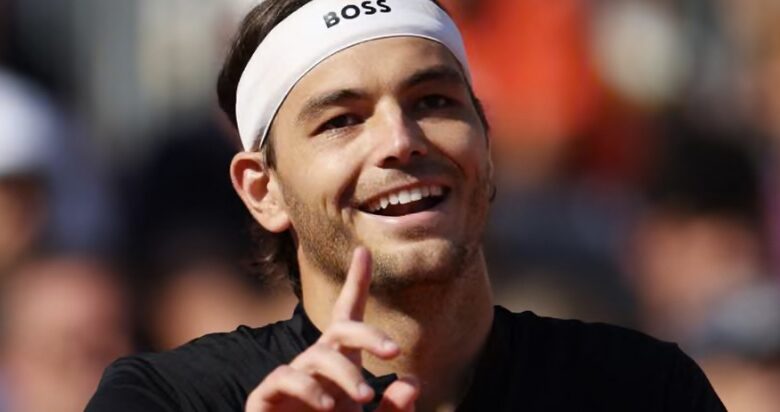
The American accepts Wimbledon might be the best chance for him to win an elusive major title at 27, and says being ‘a bit delusional’ has helped him in elite tennis
That’s the only reason I really want to be playing,” Taylor Fritz says of his quest to win a grand slam tournament as he counts down the days to Wimbledon.
Fritz, the world No 5, made the US Open final last year but he believes Wimbledon offers him the best opportunity to claim that elusive prize. He is 27 and, with each passing year, the pressure of his ambition grows.
Asked if he would feel an emptiness at the end of his career if he doesn’t win a slam, Fritz admits the truth: “I probably would. I’d probably think about it forever if I don’t do it.”


Fritz grew up with privileged opportunities and personal challenges. His mother, Kathy May, was a top-10 player who reached three grand slam quarter-finals in the 1970s, while his father, Guy, was a modest pro who eventually channelled his drive into coaching Taylor. It could be suffocating and chaotic and, at 17, Taylor removed his dad as coach and found his own way.
A year later, he was a father himself after he and his teenage girlfriend, Raquel Pedraza, a fellow tennis player, became parents to a boy they called Jordan. As Fritz adjusted to marriage and fatherhood, it took him longer than expected to develop into a major contender.
He and Perdraza divorced in 2019 and he is now part of one of tennis’s more visible couples as his girlfriend Morgan Riddle has a large following on social media and openly criticises Donald Trump and the impact his tariffs have had on the fashion industry.
Fritz is less inclined to talk politics, consumed instead by tennis. I interview him twice in a week and each encounter shows how unpredictable and difficult life on tour remains. We meet first at Queen’s Club, and have a relaxed 20-minute conversation in the early evening sunshine after a scorching day in west London
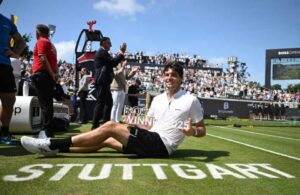
The previous afternoon Fritz had won the Stuttgart Open and beaten Alexander Zverev, the world No 3, in straight sets. It was his fifth straight defeat of Zverev and consolidated Fritz’s place as world No 4. His victory followed a dismal clay-court swing for Fritz where he had struggled with form and injury.
But his Sunday evening plane from Stuttgart to London was cancelled and his preparations for Queen’s were disrupted. He only arrived last Monday and, after a late practice session, Fritz told me: “I wouldn’t say I kept my positivity going [during his woes on clay which included a first-round loss in the French Open]. I was pretty down as a lot of my mood and happiness revolves around my results. It’s tough because, as I get better, it takes more and more to make me happy.”
Last Tuesday evening I watched Fritz lose a tight three-setter to the tricky French player Corentin Moutet who survived a match point in the second. It meant that, with Jack Draper reaching the semi-finals, Fritz had lost his place in the world top four to his British rival.
The No 5 seed could now face a potential Wimbledon quarter-final against either Jannik Sinner or Carlos Alcaraz – currently the best players on the planet by some distance.
However, when we resume our interview five days later, at Eastbourne, Fritz has recovered. Back at a tournament he has won three times, his upbeat mood is clear.
“The courts at Eastbourne always feel really good and every year I’ve won here I’ve been at Queen’s. I always feel Queen’s is very slow and slippery. I have a hard time moving there but as soon as I reach Eastbourne I move really well.
Stuttgart was also very fast but I had a nightmare getting out of there. I had to fly out the following morning, get off the plane, have one practice and play the next day. So I’m not going to be too hard on myself about losing [to Moutet]. It was a tough turnaround.”
Fritz also seems sanguine when I ask if slipping outside the top four just before Wimbledon is a blow. “No. I don’t think it’s that big a deal because if I was four and Draper five we could still have played each other in the quarters.
It now means that Novak Djokovic can’t be in my quarter. I could get Zverev [whom Fritz has beaten eight times in 13 matches] or maybe Alcaraz. Being fourth or fifth seed makes a very small difference.”
He is realistic about the gap that Alcaraz and Sinner have opened up. “We had a one-year gap in 2022-23 after [Roger] Federer retired where Rafa [Nadal] and Novak weren’t playing many tournaments.
Carlos was playing well but he wasn’t established while Sinner wasn’t fully there yet. For a year it felt like anything could happen. Now it seems we’re back to some kind of domination by Alcaraz and Sinner. But it makes me even more determined to improve.”
Fritz beat Sinner the first time they played, in 2021, but he lost their four subsequent encounters. He is yet to win a set in two matches against Alcaraz. “I’d say Carlos is the harder opponent for me but I have to add the caveat that when we played in the Laver Cup [last year] I ran into the on-fire version of him where it just feels like there’s nothing you can do. So even though obviously Sinner has gotten me several times, pretty routinely, at least in those matches I felt like I could play tennis. In the Laver Cup with Carlos I felt, for about 80 to 90% of the match, I couldn’t do anything.”